The third and final PANEURAMA report examines how rapid technological change is reshaping the European games, animation and VFX industries, and why the knowledge, skills and distinctly human capabilities that underpin creative practice are becoming more important, not less.
The games, animation and VFX industries have always evolved alongside technology. From 3D modelling and computer-generated imagery to real-time engines, virtual production and cloud-based workflows, successive technological developments have changed what can be created, how creative work is produced and which skills professionals need to participate in that process. Today, this transformation is accelerating as generative AI enters creative and production workflows and technologies increasingly move between sectors that once operated through more distinct pipelines.
Against this backdrop, PANEURAMA’s third and final research report set out to examine the technological developments shaping these industries and their implications for professionals, educators and the institutions preparing the next generation of European creative talent.
Yet one of the clearest findings to emerge from the research was surprisingly less concerned with technology itself. Participants repeatedly returned to what remains constant as tools change: deep understanding of craft, the ability to communicate and collaborate, critical judgement, business and market awareness, the capacity to continue learning throughout a career, and the human perspective that gives creative work meaning.
The central conclusion is therefore not that technological skills are becoming unimportant. Professionals and students will continue to need to understand and engage with emerging technologies. Rather, the research suggests that the more capable those technologies become, the more important the human foundations from which they are directed become.
The final chapter in three years of PANEURAMA research
This report represents the culmination of a wider three-year PANEURAMA research journey examining the relationship between creative education, professional practice and the European games, animation and VFX industries.
Earlier research on soft skills, work environments and dynamics demonstrated the importance of communication, collaboration and other transferable capabilities alongside technical expertise. The second report, focused on entrepreneurship and innovation, expanded this discussion to the business and strategic awareness professionals need to build sustainable careers and organisations.
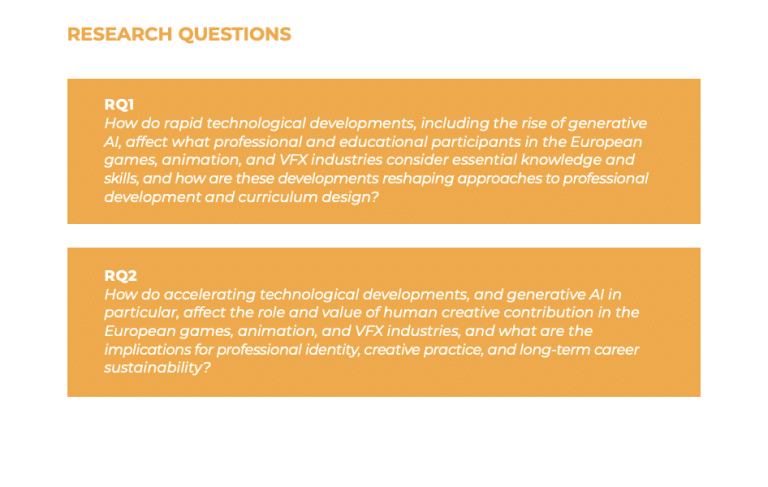
The third report brings these strands together through the lens of technological change. Drawing on 107 interviews conducted across the three-year PANEURAMA project, including 13 feature interviews with industry and education professionals in 2026, alongside survey data from two complementary studies, it asks what knowledge and skills remain essential when the technologies through which creative work is produced are changing so rapidly.
The answer that emerged connects much of PANEURAMA’s previous research: technological readiness cannot be separated from the broader development of the person using the technology.
Strong foundations in a rapidly changing industry
One of the strongest findings is that technological advancement does not reduce the need for foundational knowledge and skills; instead, it increases their importance. Participants described three interconnected dimensions: craft knowledge, soft skills and entrepreneurial thinking.
Craft knowledge provides an understanding of why things work within a discipline rather than simply how to operate the tools used to produce them. Soft skills allow that expertise to function within collaborative production environments, while entrepreneurial thinking connects creative practice to audiences, markets, value and the professional conditions that make creative work sustainable.
These foundations are particularly valuable because they travel. Software becomes obsolete, production pipelines evolve and new platforms emerge, but a professional who understands the principles beneath those tools can transfer that knowledge into a new technological context.
Generative AI makes this distinction particularly urgent because it can produce convincing outputs even when equivalent understanding is not yet in place. For students and early-career professionals, this creates the possibility of meeting the surface expectations of an assignment or portfolio piece while bypassing some of the decision-making, experimentation, failure and reflection through which deeper professional capability develops.
Participants were clear that this is not an argument for removing AI from education. Instead, students need sufficient knowledge and creative agency to use it critically, allowing technology to enhance their thinking rather than substitute for it.
This also places greater emphasis on learning how to learn. No curriculum can prepare a student for every technology they will encounter across an entire career. Formal education therefore has a dual role: establishing strong foundations while progressively developing the confidence and independence required to continue learning beyond them.
From technical competence to human distinctiveness
As generative technologies make technically competent creative output easier to produce, the research also raises a more fundamental question about what distinguishes meaningful human creative contribution.
For young talent, this question is already visible in recruitment. Hiring professionals described increasingly competitive application processes in which many candidates present technically capable work, yet relatively few portfolios communicate a distinctive creative identity. Technical competence remains essential, but it is increasingly the baseline rather than the differentiator.
As one participant summarised:
“In a world where AI can produce generic content faster and cheaper than any person, generic is the one thing you cannot afford to be.”
What becomes valuable in this environment is evidence of a person behind the work: judgement, curiosity, taste, intention and a recognisable perspective. A strong portfolio increasingly needs to demonstrate not only what someone can make, but something about how that individual thinks and sees.
The same principle extends beyond recruitment. Participants repeatedly returned to storytelling, empathy, cultural understanding and creative intention when discussing what human practitioners contribute to games, animation and VFX. Technology can expand what is possible and accelerate how it is produced, but human judgement remains central to determining which possibilities are meaningful and why audiences should care about them.
The report therefore does not frame the future as a competition between human creativity and AI. Instead, it considers how increasingly capable technologies can remain directed by human intention. The distinction is between professionals who use technology to extend their own creative and intellectual capabilities and those whose role becomes primarily checking, correcting and validating machine-generated outputs.
Simply keeping a human “in the loop” is not necessarily sufficient. What matters is whether that human continues to exercise meaningful agency within it.
New technologies, new careers and an old talent challenge
Technological convergence is also changing how careers develop. The T-shaped professional, combining depth in one discipline with broader awareness of adjacent roles and the wider production pipeline, remains the profile most widely valued for graduates. Over a longer career, however, participants increasingly identified what the report describes as an M-shaped professional: someone who has developed genuine depth in more than one area through sustained experience.
As technologies and workflows move between games, animation, VFX, virtual production and adjacent sectors, professionals have more opportunities to build additional areas of expertise. Education does not need to produce M-shaped graduates; instead, it can establish strong T-shaped foundations while helping students recognise that their first specialism does not have to define the limits of their career.
At the same time, technological change is creating a more immediate challenge for the talent pipeline. Some of the repetitive and clearly defined tasks traditionally allocated to junior professionals can increasingly be supported or automated through AI-assisted workflows. While this may create short-term efficiencies, participants emphasised that junior roles have never served a production function alone. They are also environments in which future professionals learn through repetition, feedback, supervised responsibility and exposure to professional decision-making.
If those opportunities diminish, the consequences extend beyond graduate employment. The industry must also consider how the next generation of experienced professionals will develop if some of the work through which previous generations learned is no longer available.
Entry-level work produces future experts as well as production outputs.
Investing in people through technological change
Across three years of PANEURAMA research, a consistent picture has emerged. Preparing Europe’s games, animation and VFX sectors for the future cannot be reduced to providing access to the latest technologies, particularly when the tools considered essential today may occupy a very different position within the industry only a few years from now.
What endures is the capacity to understand the principles beneath those tools, communicate and collaborate with others, recognise the wider professional context of creative work, continue learning throughout a career, exercise critical judgement and bring a distinctive human perspective to the creative process.
For education, this means protecting foundational learning while developing independent learners. For industry, it means considering talent development, junior pathways and professional agency alongside productivity. For students and professionals, it means developing depth while remaining open to new technologies, disciplines and contexts, and cultivating a perspective that technology can amplify rather than replace.
The third PANEURAMA report began by investigating technological change. What emerged was a much more human conclusion: the tools will continue to evolve, but the ability to understand, collaborate, learn, judge and create with intention is what allows people to evolve with them.
Explore and download the full PANEURAMA Year 3 research report to discover the complete findings, interviews, sector insights and implications for the future of European creative education and industry.